Home Brewing Supplies
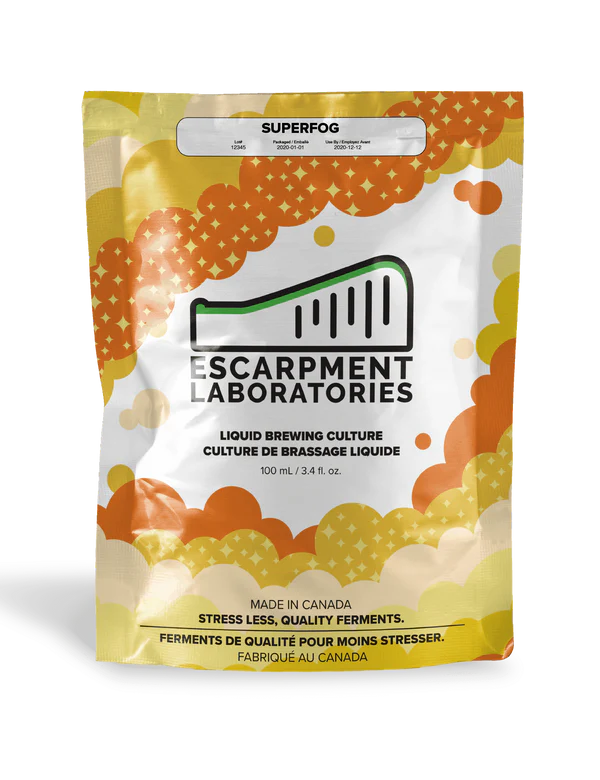
Liquid Yeast – Escarpment SUPERFOG
$21.99
| Weight | 0.153 kg |
|---|---|
| Dimensions | 15 × 2 × 20 cm |
| Yeast Type | Liquid Yeast |
| Strain | Ale |
| Flocculation | Medium |
| Alcohol Tolerance | Medium (10%) |
| Temperature Range | 16-22°C |
| Attenuation | 70-80% |
Escarpment SUPERFOG – Liquid Ale Yeast
Escarpment SUPERFOG is a hazy-focused ale yeast from Escarpment Laboratories that’s built for juicy, modern hoppy beers. It’s designed to push big fruit character, keep haze stable, and finish with a soft, pillowy mouthfeel. If you like New England IPAs, hazy Pale Ales, and hop-saturated “juice bombs,” this is the kind of strain that makes them really shine.
This liquid yeast brings forward expressive stone fruit and tropical notes, while still letting your hops do most of the talking. Expect a round, slightly sweet impression — not cloying, but definitely not bone-dry and bitter. SUPERFOG’s medium flocculation helps maintain that hazy look you’re after without turning the beer into murky sludge.
Best Styles for SUPERFOG
- New England IPA / Hazy IPA
- Hazy Pale Ale
- Juicy Double IPA (within the 10% range)
- Oat or wheat-heavy hop-forward ales
- Hazy, modern “XPA” / session-strength IPAs
SUPERFOG is all about hop-forward, haze-positive ales. It can work in a fruity American Wheat or a soft, modern Blonde, but it really earns its keep when there’s a lot of late and dry hops in the recipe. If your goal is a bright, clear West Coast IPA, this isn’t the strain for that – it’s meant to keep things juicy and hazy.
Fermentation Profile & How to Use It
The recommended temperature range for Escarpment SUPERFOG is 16–22 °C. For most homebrewers, that translates roughly like this:
- 16–18 °C: Cleaner fermentation, slightly less ester-heavy. Good if you want hops fully in the spotlight with minimal yeast character.
- 18–20 °C: Nice balance of fruitiness and hop expression. This is a great “default” range for hazy IPAs and Pale Ales.
- 20–22 °C: More expressive fruit character and slightly faster fermentation. Useful for big, juicy IPAs where some extra ester profile is welcome.
With medium attenuation and medium flocculation, you can expect a moderately full final gravity that supports a soft, rounded body. Plan your recipe with enough chloride (through your water profile or calcium chloride additions) and some wheat or oats to really lean into that texture. Alcohol tolerance is about 10% ABV, so you’re safe brewing up to a big Double IPA, but for anything beyond that you may want to pitch extra yeast or consider a more alcohol-tolerant strain.
Flavour, Haze, and Pairing Ideas
SUPERFOG typically gives stone fruit, tropical, and soft fruity esters that layer nicely under modern hop varieties. It pairs especially well with:
- Hops: Citra, Mosaic, Galaxy, Nelson Sauvin, Sabro, El Dorado, and other “juicy” or tropical-forward varieties.
- Malt: Pale or Pilsner base malt with 10–30% oats and/or wheat for extra haze and mouthfeel. Light crystal (if any) to avoid too much sweetness.
- Other yeast: Can work in split batches with a clean American ale strain for side-by-side comparisons, but it’s best used on its own when haze and fruitiness are the main goal.
SUPERFOG is not typically categorized as a strongly phenolic strain (so you won’t get clove or pepper like a Belgian or saison yeast) and it’s not known as a highly diastatic strain. That means it won’t chew your beer down bone-dry or over-attenuate the way some saison strains will. It can absolutely be used in mixed fermentations with Brettanomyces or bacteria if you’re experimenting, but its main purpose is clean, hazy, hop-forward ales rather than sour or funky projects.
Why Choose SUPERFOG?
You’d reach for Escarpment SUPERFOG if your priority is a reliable hazy IPA yeast that keeps haze in suspension, supports a juicy finish, and still ferments in a reasonable timeframe. Compared to more neutral American ale strains, it brings more fruity character and a softer body. Compared to very aggressive “juice” strains or diastatic yeasts, it’s a bit more controlled and won’t dry your beer out too much.
If you’ve brewed NEIPAs with standard American ale yeast and found them a bit too clear, sharp, or lacking that “pillowy” texture, SUPERFOG is a strong candidate for your next batch. Pitch an appropriate cell count, oxygenate well (especially for higher gravity beers), control your temperature in the 18–20 °C range, and it will reward you with a stable haze and a nicely saturated hop profile tailor-made for Vancouver’s hop-loving brewing scene.